
Basketball article
A 60-Minute Youth Basketball Practice Plan Built Around Touches
A good youth basketball practice keeps the ball in children’s hands and gives them decisions they can understand. This 60-minute youth basketball…
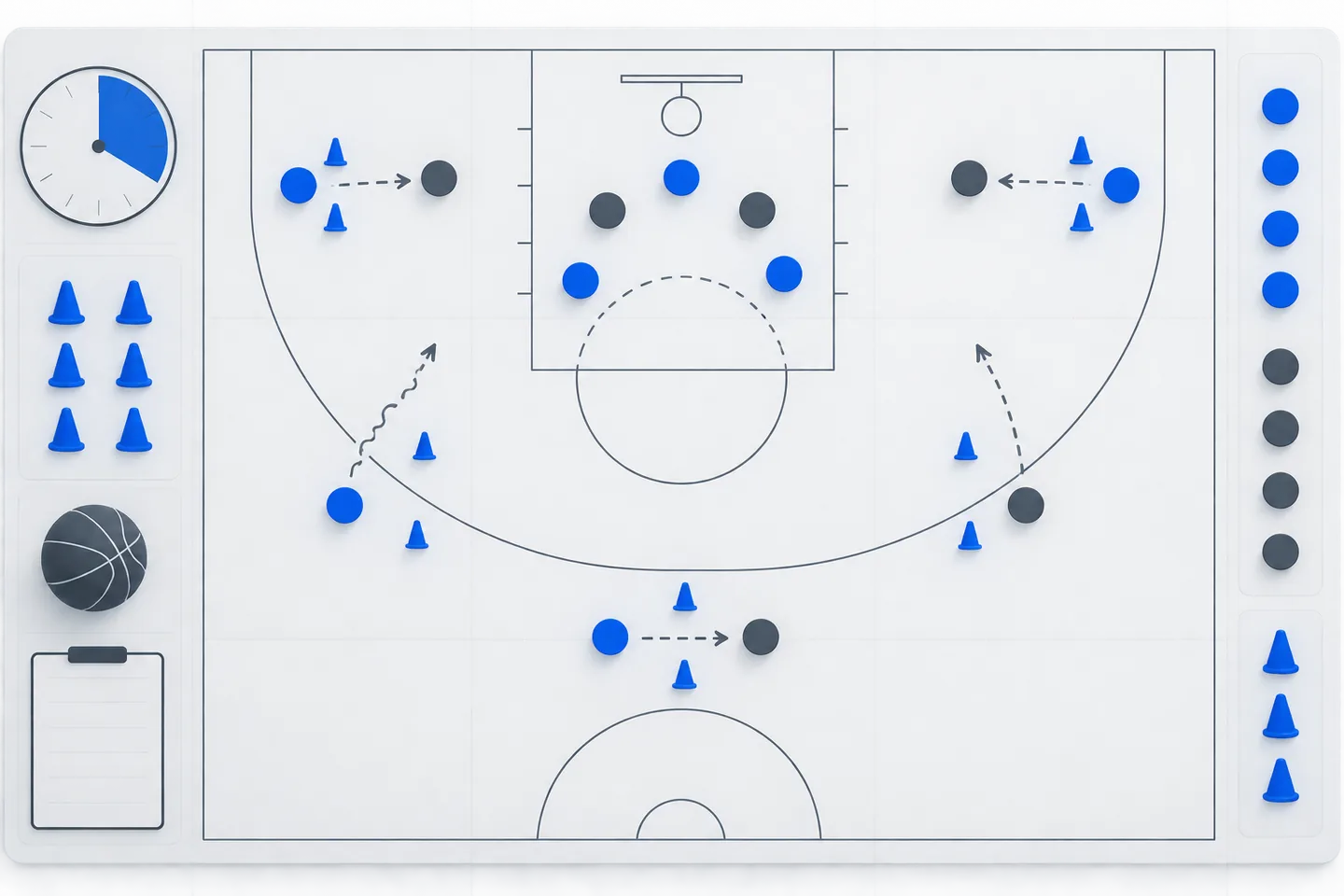
A good youth basketball practice keeps the ball in children’s hands and gives them decisions they can understand. This 60-minute youth basketball practice plan is a ready-to-use session for novice 8–10-year-olds. It moves from individual ball control to a defender, then to teammates, and finishes with a game. You can run it with one coach, a half court, cones, and ideally one ball per player.
The schedule is a guide, not a test of whether you can reach every minute mark. If a game is working, let it breathe. If children are waiting, confused, or frustrated, simplify it and get them moving again. That approach fits the Jr. NBA instructional curriculum, which uses small-sided games and changing levels of difficulty to help young players learn through play. FIBA’s Mini-Basketball coaching manual likewise emphasizes active, achievable activities with little time spent watching or listening.
Before the session
Set out two or three small playing areas before players arrive. Keep your instructions to one sentence and a quick demonstration. The timed sections below include brief transitions and water breaks.
Bring: balls, a few cones or floor markers, water, and a watch. Smaller or lighter balls and an accessible basket can make the session more workable for beginners. If you have only one hoop, keep the passing game away from it and use an end line as a scoring target in one 1v1 area. Before play begins, show players the boundaries and where to wait if they need a rest.
Run the hour without building a line
0–6 minutes: Start moving
Mark a safe playing area and ask everyone to travel through the open spaces. Call “stop” for a balanced two-foot landing, then “go” for a new direction. Vary the movement: walk, skip, shuffle, or move backward only when the space is clear. After a couple of rounds, give each player a ball and invite them to bounce while moving. A child who cannot yet dribble and travel can carry the ball to an open spot, stop, and try a few controlled bounces there.
Avoid eliminating players when they lose control. They retrieve the ball and rejoin. You are looking for movement, awareness, and a comfortable start, not a winner. The Jr. NBA’s Rookie practice plans similarly begin with active games and offer ways to adjust activities for different players.
6–16 minutes: Give every player a ball-handling task
Make several “gates” from pairs of cones. Players dribble through any gate, stop, turn, and choose another. Keep the gates far enough apart to prevent collisions. After two minutes, ask players to visit a gate they have not used. Later, offer an optional challenge: change hands after a gate, or pause and look up before choosing the next one.
Do not turn this into ten minutes of corrections about hand position. Watch for players who are spending most of the time chasing the ball or staring at the floor. Move a gate closer, widen it, or let them walk. For a confident player, narrow a gate or ask for a change of direction. The activity stays the same while the challenge changes.
16–26 minutes: Add a teammate
Put players in pairs with one ball per pair. They choose a gate, pass through it, catch, and move together to another gate. Once they understand the pattern, the receiver chooses the next destination. Switch that role every minute or two. If a pass misses, both partners collect it and carry on; there is no score to erase.
Keep pairs spread across the court. With an odd number, make one group of three and rotate the passer after each catch. Beginners can stand closer and make a two-handed pass. More comfortable pairs can move before the pass or choose a gate while a nearby pair occupies another. Ask, “Where could you move so your partner can see you?” That question prepares them for the decisions in the games ahead.
26–38 minutes: Let players solve a 1v1 problem
Set up several narrow lanes, each with a basket, cone target, or end line to reach. In each pair, one player attacks and the other defends. Start the attacker with the ball and give them a few seconds to score or cross the end line under control. Then switch roles. Short turns matter: if a player waits longer than they play, create another lane or shorten the round.
Begin with the defender one step away and ask them to stay between the attacker and the target without grabbing. The attacker’s choice is simple: move into open space or change direction when the defender closes it. Pause only long enough to ask, “What space did you see?” If steals end every turn immediately, have the defender shadow without reaching for a round. If attackers succeed too easily, bring the defender closer. These changes preserve the same decision while making it achievable.
38–48 minutes: Connect the decisions in 3v3
Make small teams and play across a half court or toward marked end zones. If space allows, run two games at once. Keep possessions short and restart promptly after a score, a stop, or a ball out of bounds. Tell the team with the ball to look first: is there room to move, or is a teammate open? After a pass, the passer moves into a new space rather than standing to watch.
Give only one team challenge at a time. For example, award a point for reaching the target after more than one player has handled the ball. Remove that condition if children start making unnecessary passes instead of taking an open chance. The aim is meaningful choices for everyone, not a rule that slows every possession. If three attackers are too many for a new group, use 2v2 until players recognize where to move.
48–60 minutes: Finish with play and a brief reflection
Use the final ten playing minutes for a game with as few added rules as possible. Rotate teams every few minutes, or after a small number of possessions, so the same players do not control the whole finish. Restart with a pass from the side instead of sending everyone back to a long line. When the ball goes out, return it quickly and play on.
At 58 minutes, gather balls and ask players to tell a partner one thing they noticed: an open space, a useful pass, a successful stop, or a choice they would try again. Invite a few answers while equipment is collected. This is a closing check, not a speech or a ranking of players.
Adjust the plan to the children in front of you
Age is a starting point, but skill varies within any age group. FIBA’s Mini-Basketball manual advises coaches to vary an activity to suit each player’s experience, rather than assuming all children of the same age need the same challenge. Keep the session’s sequence and change the space, pressure, or task.
- For younger or newer players: make gates wider, bring partners closer, allow a catch before another dribble, and use an end line when a basket feels too difficult. Start 1v1 with a passive defender.
- For confident 10-year-olds: ask them to look up before changing direction, start 1v1 with a live defender, or challenge them to move into a new space after each pass. Add one condition at a time.
- For mixed groups: adjust within the same game. One player can use either hand while another tries the less familiar hand; one pair can pass through a wide gate while another uses a narrow one.
If players look tired, shorten the playing area, allow a water break, and keep the next game brief. If they are frustrated, remove a defender’s pressure or make the target easier to reach. If attention is drifting, stop explaining and start a short round with one clear cue. Do not make a tired group earn rest through extra running.
Check whether the practice delivered touches
You do not need a complicated tally. During each activity, scan the court: who has a ball, who is moving to receive one, and who is waiting? Notice whether each player gets repeated turns in 1v1 and makes a choice during 3v3. At the end, ask yourself whether a few children dominated the game or whether the quieter players found ways in.
Use those observations to change the next practice. More balls, smaller groups or a wider gate may help more than a new drill.