
Basketball article
What Is the Top of the Key in Basketball?
By Tariq Evans
The top of the key is the central area immediately above the free-throw circle, at the end of the lane farthest from the basket. It gives a player a direct
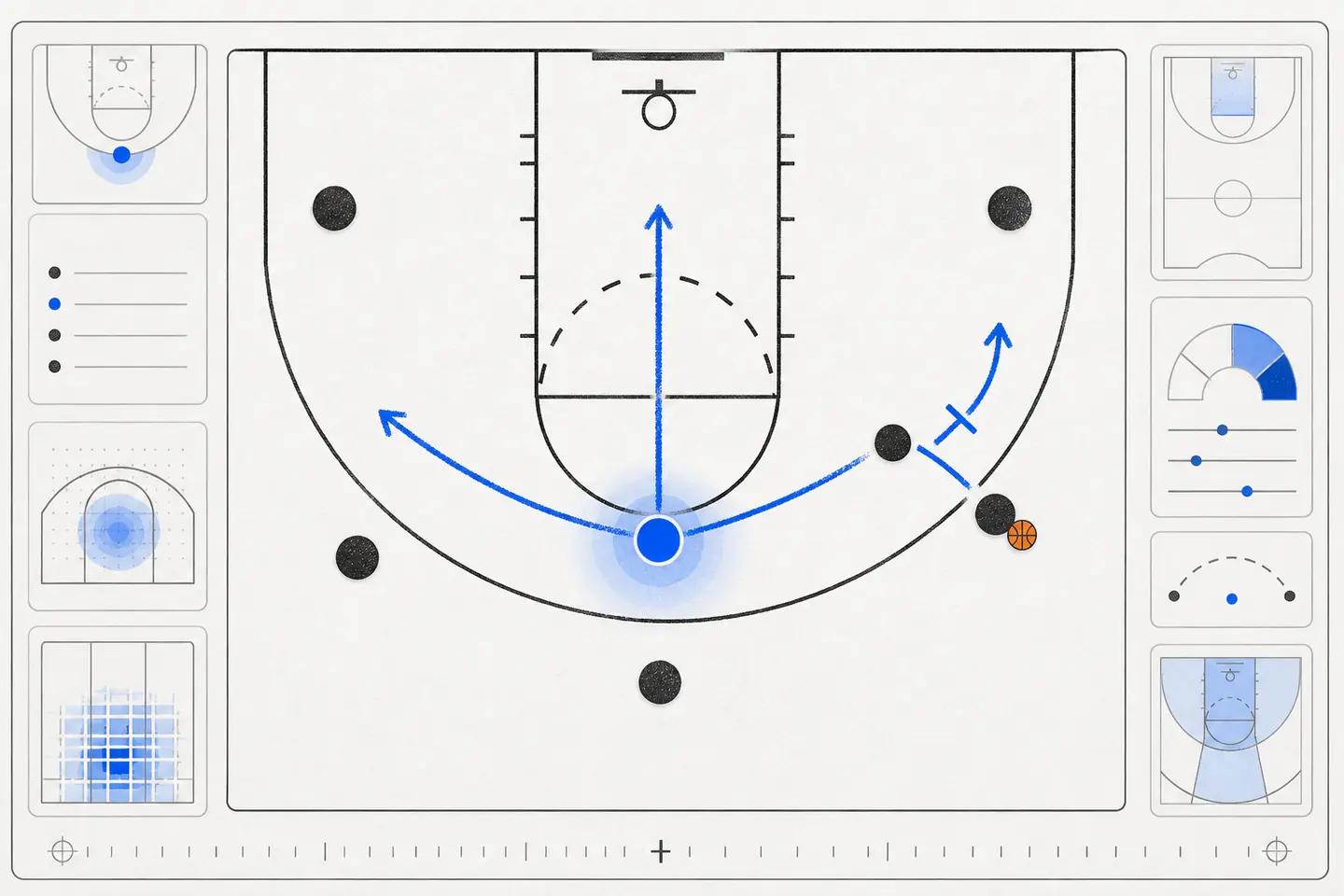
The top of the key is the central area immediately above the free-throw circle, at the end of the lane farthest from the basket. It gives a player a direct view of the rim and passing angles to both sides of the court. Teams often use it to begin an attacking move, set a high screen or reverse the ball.
The name comes from the shape formed by the lane and free-throw circle. Together they once resembled an old-fashioned key, although modern court markings are usually more rectangular. The basketball key is also commonly called the lane or the paint.
Players and commentators sometimes use “top of the key” loosely for a wider central area. They may mean the space around the top of the free-throw circle, or the central position near the three-point line. The exact spot becomes clear from the action being described.
How to Find It on the Court
Start at the basket and look towards the free-throw line. The painted lane runs from the baseline to that line. A circle is centred on the free-throw line, with one half inside the lane and the other half extending away from the basket. The point on that outer half farthest from the rim is the top of the key.
It is useful to distinguish the location from four nearby features:
- The free-throw line forms the upper boundary of the lane and passes through the middle of the free-throw circle.
- The high post is a playing area around the free-throw line and elbows, usually occupied by a forward or centre.
- The elbows are the two corners where the free-throw line meets the sides of the lane.
- The three-point line is the larger arc farther from the basket. A central player may stand behind it while still being described informally as “at the top”.
Court dimensions and markings differ between competitions, so a coach should use the lines on the actual court rather than assuming every venue is identical. A guide to basketball court lines and areas can help new players learn the neighbouring reference points.
Why the Position Matters
The top of the key is valuable because it is central. A ball handler there can pass to either wing, find a player near either block, attack down the middle or move the ball back towards halfway. The defence cannot load one side as easily as it can when the ball is near a sideline.
The position also supports good spacing. If one player has the ball at the top, teammates can occupy the wings, corners and interior without standing in the same passing lane. The ball handler can see most of the half court without turning away from the basket.
Central position does not guarantee an advantage. A player who dribbles in place allows defenders to settle, while careless cross-court passes invite interceptions. The purpose of using the top is to create a decision quickly: shoot when open, drive into a genuine gap, pass to a better-positioned teammate or begin the next action.
Common Attacking Actions
Ball Reversal
When the ball reaches the top from one wing, the receiving player can move it to the opposite wing. This reversal makes defenders change their stance and travel across the court. A late rotation may leave a teammate open to shoot, drive or pass inside.
The player at the top should catch facing the basket, protect the ball and scan before the pass arrives. Holding the ball above the head may help against pressure, but the passer still needs balance and a clear lane. A rushed overhead pass across several defenders is rarely the safest choice.
High Pick-and-Roll
A teammate can screen the on-ball defender near the top. The ball handler then uses the screen to turn the corner towards the basket. The screener may roll towards the rim, move into open space for a pass or set another screen if the first action creates no advantage.
The other attackers must keep useful distances. If they drift towards the ball, their defenders can help without giving up an easy pass. Width in the corners and on the wings leaves more room for the handler and screener to read the defence.
Handoffs, Cuts and High-Low Play
A dribble handoff at the top combines a short pass with a screen. The receiver runs close enough to prevent the defender slipping between the two attackers. The player giving the ball must remain still when contact occurs and avoid extending a hip, shoulder or arm into the defender.
A forward at the high post can also receive the ball, face the basket and look for cutters. In a high-low action, that player passes to a teammate establishing position closer to the rim. The angle is often better from the centre than from the wing, but the passer must account for defenders reaching from both sides.
Cutters should move with a purpose. One can cut behind a defender who is watching the ball, then clear the lane if the pass is unavailable. Repeated cuts through the same space only crowd the interior.
How Defenders Protect the Top
A defender wants to prevent the ball handler from driving straight through the middle. A balanced stance, active feet and an angle towards planned help are more reliable than reaching for the ball. Forcing the handler towards one side reduces the number of immediate passing options.
Against a high screen, all defenders need to recognise the chosen coverage. They might switch assignments, send the on-ball defender over the screen, allow space underneath it or briefly step up with the screener’s defender. Each choice concedes something, so the response should match the handler’s position and the available help.
Off-ball defenders must see both their player and the ball. Moving too far into the lane can leave a simple pass to the perimeter; staying too wide can expose the rim. Useful defence at the top depends on early communication, short recovery routes and a clear plan for the rolling screener. Broader coaching philosophy and game-plan approach should define those responsibilities before a match.
Rules Around the Key
The top itself is not a special restricted spot. A player may stand there during ordinary play, and the ball can move through it freely. Several rules apply to the lane and free-throw circle nearby, however, and their details can vary by competition.
Many rule sets limit how long an attacking player may remain in the lane while their team controls the ball. Standing at the top, beyond the lane boundary, is different from occupying the paint. Players should still avoid treating the edge of a line as a safe hiding place because an official judges their actual position.
During a free throw, the shooter stands behind the free-throw line. Other players either occupy marked spaces beside the lane or remain outside the required boundary until the attempt is released. The top of the key provides a clear reference point for players waiting beyond the free-throw circle.
Rules governing court dimensions, free throws and lane violations are not identical at every level. Coaches and officials should consult the rules for their own competition. The NBA rulebook is one example of official documentation rather than a universal rule for all basketball.
Simple Practice Drills
Locate and Name
Ask players to walk to the top of the key, free-throw line, elbows, wings and corners as each location is called. This quick exercise gives beginners a shared vocabulary. Repeat it from both ends of the court so they learn the markings rather than memorising one view.
Catch, Face and Decide
Place a passer on one wing and a receiver at the top. On the catch, the receiver faces the basket and chooses between a pass to the opposite wing, a controlled drive or a shot. Add a defender once the footwork is consistent. The aim is a prompt read, not a predetermined move.
Three-Player Screen Read
Use a ball handler, screener and defender. Begin at walking speed so the screener can set a legal position and the handler can pass close to the screen. Then give the defender different responses. The attackers must recognise whether to turn the corner, pass to the roller or move the ball elsewhere.
Keep the drill connected to realistic spacing by adding stationary targets on both wings. Even without extra defenders, the ball handler should look towards those targets before deciding. This builds the habit of seeing the whole court from the top.