
Basketball article
Coaching Basketball Fundamentals
By Tariq Evans
Coaching basketball fundamentals means teaching players to move with control, handle the ball, read the floor and choose an appropriate action. Drills prov
Coaching basketball fundamentals means teaching players to move with control, handle the ball, read the floor and choose an appropriate action. Drills provide repetition, but players also need opportunities to use those skills against defenders. Build each practice around a specific problem, such as receiving under pressure or stopping before a pass, then test the skill in play.
Fundamentals include footwork, ball handling, passing, shooting, rebounding, screening and team defence. A governing body's coaching guide provides a structured reference. Its player-development curriculum offers a framework for organising these areas. Use observed ability to choose the next challenge rather than assuming that everyone of the same age needs identical work.
Observe before choosing a drill
A player may dribble confidently with either hand yet struggle to stop under control. Another may shoot comfortably from a stationary position but lose balance after a catch. Watch a short game or partner exercise before deciding what to teach. Look for actions you can describe and repeat:
- Stopping, pivoting and protecting the ball without travelling.
- Passing ahead of a moving teammate with suitable pace.
- Looking at the court before receiving the ball.
- Finishing from both sides of the basket.
- Staying between an attacker and the basket without reaching.
Select one or two priorities. Adjust space, speed or defensive pressure for individual players while keeping a common task. If someone loses control on nearly every attempt, simplify the exercise. If they complete it comfortably without looking up or making a decision, add a defender or another option.
Connect footwork to possession
Teach ready position, controlled stopping and pivoting before adding complicated combinations. Start with a pass and catch: the receiver stops in balance, identifies their pivot foot, turns away from a passive defender and passes to a partner. Check that the player can protect the ball without swinging elbows or moving the pivot foot illegally.
Progress by letting the defender deny one passing direction. The receiver must now use the pivot to find an open angle. Keep the defender's pressure manageable until the receiver understands the movement. A successful repetition ends with a balanced, accurate pass, not simply an escape from pressure.
Use the same attention to control on defence. Practise approaching an attacker, slowing before reaching them and reacting to a drive. A defender who arrives too fast may concede a driving lane even when the initial sprint looks energetic.
Teach handling, passing and receiving together
Ball handling should help a player travel through space, protect possession or create a passing angle. Begin with changes of pace and direction using either hand. Ask players to look towards a partner or an open area, rather than keeping their attention fixed on the bounce.
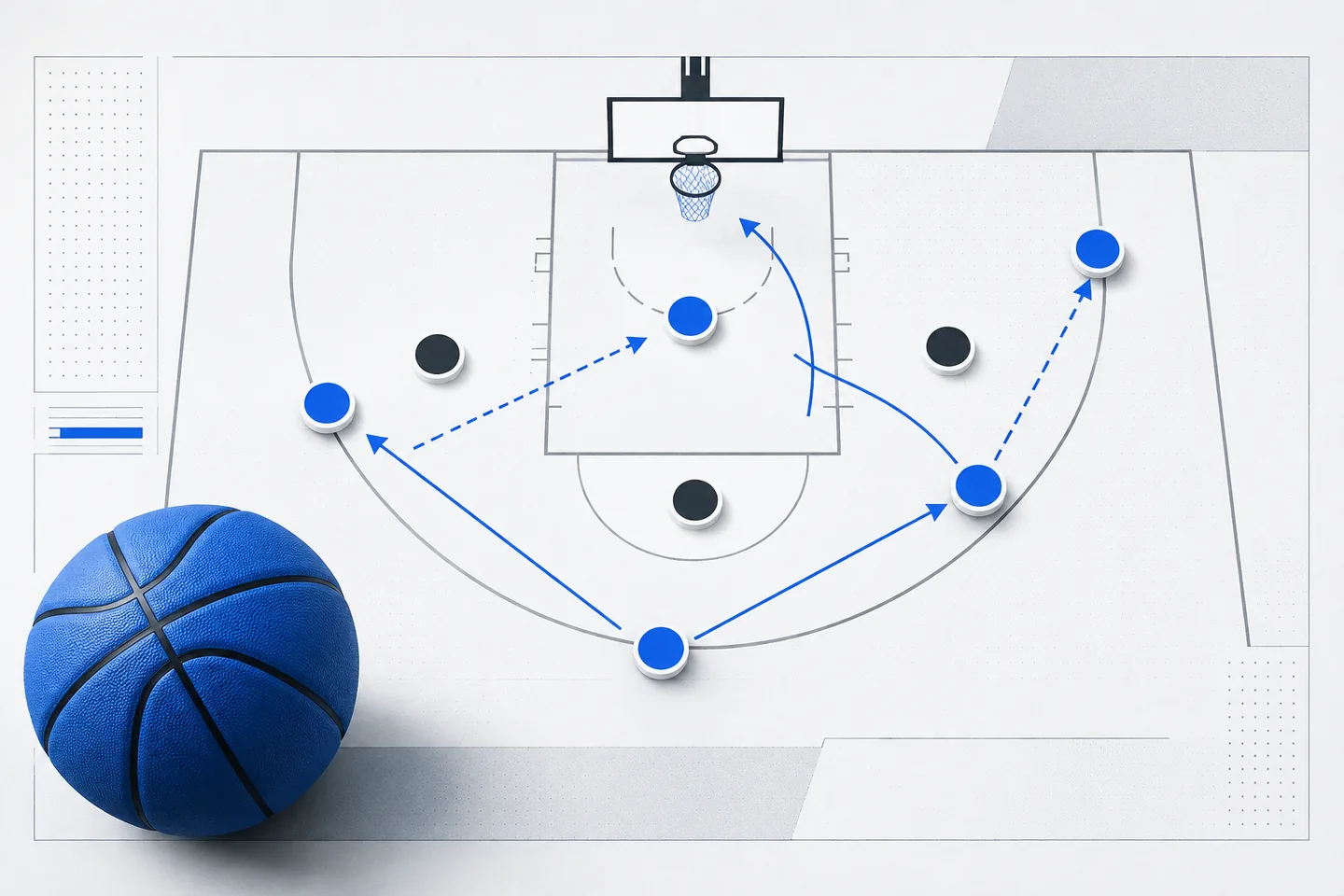
Add a simple choice: a partner moves into one of two passing lanes while the ball handler approaches. The handler reads the movement, stops under control and delivers the pass. Later, introduce a defender who blocks one lane. This connects dribbling to a useful next action.
Teach passes to arrive where the receiver can use them: ahead of a cutter, away from a defender or near the receiver's ready hands. The receiver should show a target, watch the ball into the catch and establish balance. If passes repeatedly go astray, check timing and spacing as well as throwing technique.
Build shooting and finishing from balance
Start close enough to the basket that players can shoot without straining or changing their action to reach the hoop. Look for balance, a comfortable release and a repeatable rhythm. Move further away only while those qualities remain. Avoid rebuilding the whole technique after each miss; identify a recurring pattern first.
Connect stationary shooting to a catch, then add movement before the catch. Have a partner vary the pass slightly so the shooter must organise their feet. Add a controlled closeout and allow a drive or pass when the shot is covered. Evaluate the decision separately from whether the ball goes in.
Practise finishes on both sides, beginning close to the basket. Give the less comfortable hand regular attempts without making misses a punishment. Introduce a defender gradually so players learn when the basket or their body can help protect the ball.
Include defence and rebounding
Teach defenders to see their opponent and the ball, adjust their position as passes travel and communicate before help is needed. In two-on-two, pause occasionally to check whether the defender away from the ball can help against a drive and still recover towards their own opponent.
Reward controlled contests and good positioning, not only steals. Reaching for every pass can leave space behind the defender. Ask players to explain what they were protecting: the basket, a driving lane or a passing option.
Finish defensive exercises with a rebound. Players should locate an opponent, establish legal position, pursue the ball and secure it before making an outlet pass. Rotate roles so everyone practises rebounding and starting the next possession. A defensive stop is unfinished while the ball remains available to the attack.
Progress towards realistic decisions
Use isolated repetition to introduce an unfamiliar action, then vary the situation. The FIBA coaching manual is a further reference for planning skill practice. A practical progression is:
- Demonstrate the movement and allow unopposed attempts.
- Add a passive defender who presents a clear obstacle.
- Give the attacker two options, such as passing or driving.
- Let the defender react freely within a small playing area.
- Use two-on-two or three-on-three to check transfer into play.
Choose constraints that support the lesson. For passing practice, a temporary dribble limit can encourage players to move and offer an angle. Remove the limit afterwards to see whether that behaviour remains. Avoid rules that force players to ignore an obvious scoring opportunity just to satisfy the exercise.
Give feedback players can use
Keep corrections brief and observable. Ask a player to stop in balance before passing, rather than simply demanding a better pass. Give them another attempt promptly. Too many instructions between repetitions make it difficult to know which change mattered.
Use questions when the player has enough information to answer: where was the defender, which passing lane was open, or what changed after the catch? When the movement is unfamiliar, demonstrate it directly. Identify successful actions as precisely as errors, including early communication or keeping vision up during a change of direction.
Plan a session around one theme
For a session on receiving under pressure, begin with movement and controlled stops. Follow with partner passing and pivoting, then add a defender who denies one side. Finish with three-on-three, watching whether receivers create space and look before catching.
Keep groups small enough that players spend more time practising than queuing. Rotate partners and positions. If equipment or court space is limited, use partner tasks away from the basket for passing and footwork, then swap groups so every player gets opportunities to practise finishing. Plan pauses for water and explanation, and shorten an activity when fatigue prevents controlled movement. Increase the challenge through decisions before simply increasing speed.
At the end, record one behaviour that improved and one to revisit. At the next practice, check the same skill in a short game before repeating the drill. This gives the next session a clear starting point and shows whether players can use what they practised without constant reminders.