
Basketball article
Basketball Spacing Basics: Teach Passing Lanes Before Set Plays
Basketball spacing begins with a question a young player can answer during a game: Can my teammate pass to me from here? Standing away from the ball is…
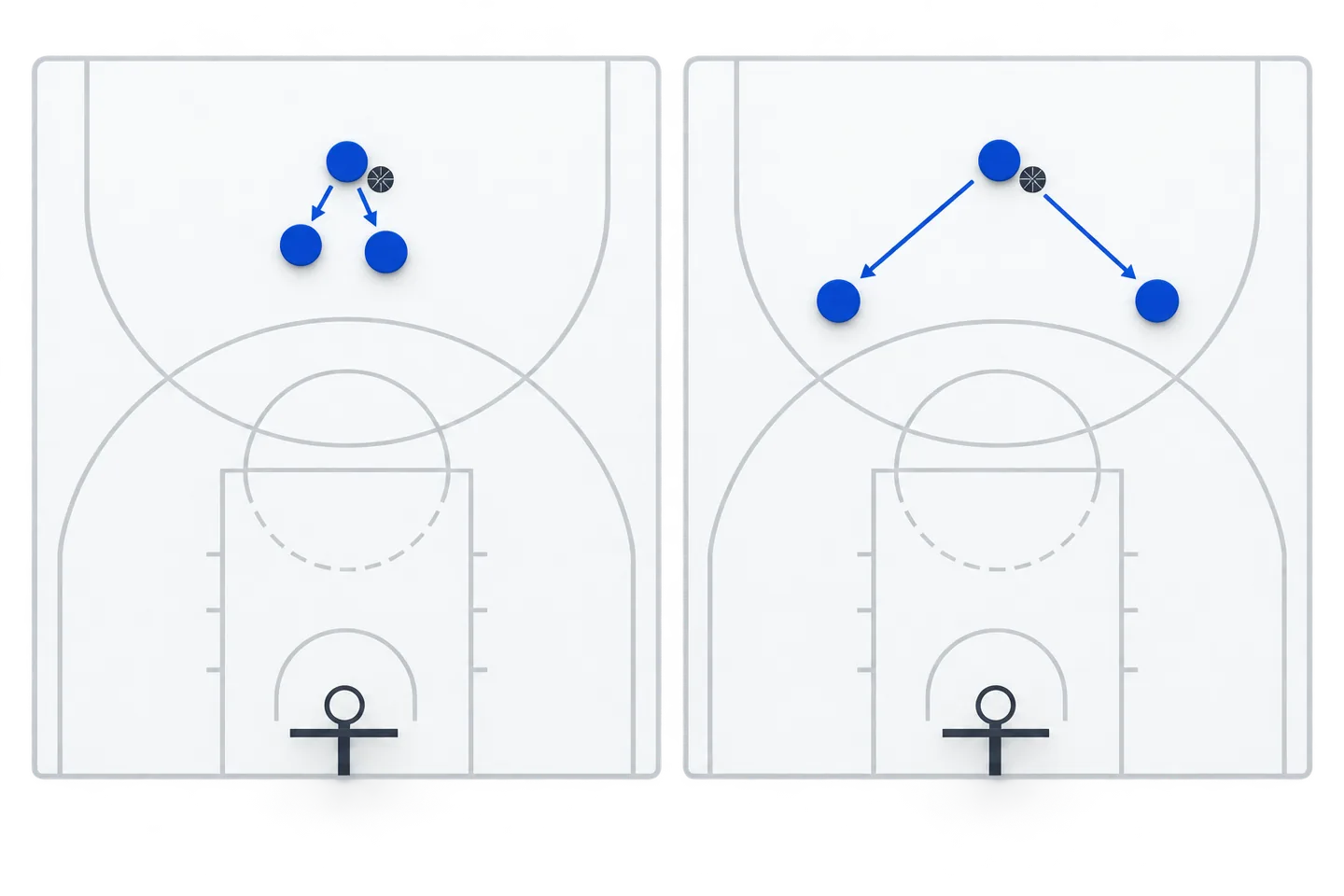
Basketball spacing begins with a question a young player can answer during a game: Can my teammate pass to me from here? Standing away from the ball is not enough. A defender may block the line, or the pass may be longer than the players can manage. Useful spacing gives the ball handler a reachable option and leaves room for another player to move.
Beginners often gather around the ball because short passes feel safer. The FIBA mini-basketball coaching manual describes this tendency and warns that positions in deep corners can make the pass too long for young players. Teach a short, open pass without bringing every receiver into the same patch of court.
Start with three-on-three
Set up three attackers against three defenders on a half court. Give A the ball near the top. If B and C both run towards A, one defender may threaten both passes and the attackers lose room to cut. Ask B and C to find separate passing angles. They need not hold fixed wing positions: they should move as the defenders move, while staying close enough to catch a controlled pass.
Ask, “Which teammate could A pass to now?” Let a defender step into one lane, then ask again. B or C can move sideways, briefly come towards the ball or cut behind a defender to offer a new line. A passing lane is an angle available at that moment, not a spot marked on the floor. If the ball handler cannot deliver the pass, the receiver may need to come nearer even if that makes the formation look less wide.
Freeze a possession when both receivers arrive beside the passer. Ask which player has the clearer angle and where the other could move. Restart from the same position so players can try their answer. Keep the pause brief; repeated decisions against moving defenders teach more than a lengthy explanation of where everyone should stand.
Add a fourth player without making a crowd
Four-on-four offers another potential short pass, but only if the extra player occupies useful space. Begin with three receivers in distinct areas. They can move closer, farther away or towards the basket as play develops. When one cuts into a teammate’s area, the teammate should notice the space left behind. FIBA uses four-on-four to teach players how to move together and explains how stopping near the ball can both occupy another player’s space and make a pass easier to intercept.
Give the group one prompt: “If someone enters your space, where can you help next?” Avoid assigning a permanent corner or a compulsory circuit of positions. A player might replace a cutter, move into the passer’s view or stay put because their existing passing lane is open. The decision depends on the ball, the basket and the defenders.
Choose a distance players can use
There is no single spacing distance for every beginner. Separate receivers enough that one stationary defender cannot guard both easily, then check whether the passer can reach either one. If passes regularly sail beyond a receiver, shorten the gap or the playing area. If two attackers repeatedly stand shoulder to shoulder, ask one to find a different angle. Judge the task by what this group can pass and catch, not by age alone.
Look for a clear route to the receiver’s hands as well as a manageable distance. A receiver directly behind a teammate can be nearby yet unavailable. A small step sideways may open the line. A cut towards the basket can create a brief option; if the pass does not come, the cutter should leave the lane for someone else. Deep corners may leave plenty of empty court while putting a basic pass out of reach.
Teach pass, cut and replace as decisions
FIBA includes pass, cut and replace in its small-sided teaching examples. Introduce the movement without defence, then add a defender so each action has a reason.
- Pass. A passes to B and looks at the space between B and the basket instead of following the ball to stand beside B.
- Cut. If there is a clear route, A moves towards the basket and shows a target for a return pass. B passes only if that lane is open.
- Replace. If A does not receive the ball, A moves out. C can move into the space A left, giving B another option.
Practise a few times without a defender. Then let one defender deny the return pass. The cutter must recognise when to clear the lane, and C must see the gap. Finally, play three-on-three. Do not stop a possession because a player drives, shoots or chooses a better pass instead of completing the sequence. The movement creates options; it is not a rule requiring a second pass.
Use a short cue while they play: “Pass. Look. Cut if it’s open. Clear out if it isn’t.” If a closely guarded receiver only calls louder, ask how they could change the passing angle. Show one example, then give the defender freedom to react. This keeps the exercise about seeing space rather than rehearsing an unopposed route.
Test the idea in small-sided games
The Jr. NBA instructional curriculum uses small-sided games to develop decisions through play. These three prompts let a coach check whether players can find passing lanes when defenders make choices.
Find two passing lanes
Play three-on-three on a half court. Before the ball handler dribbles, the two receivers try to offer different passing angles. Neither has a permanent wing. Let the defence play normally. Watch whether receivers separate, face the ball and move when a defender closes a lane. If both approach the passer, pause once and ask, “Could one defender reach both passes?” Then replay the situation. A sensible move still counts as a useful attempt if the eventual pass is missed.
Pass, cut or clear
In three-on-three, require the passer to move after passing for a few possessions. They may cut if the lane opens or move away if it closes. Then remove the condition. Watch whether the player still moves purposefully when free to choose. Ask what the defender left open and whether the ball handler saw a better option. Reward the reading of play rather than completion of a preset pattern.
Make the next pass possible
Start four-on-four with players in distinct areas. After each pass, ask the players away from the ball to check whether a nearer passing lane has opened. They may cut, exchange spaces or hold a useful position. Watch the player who cuts without receiving the ball: do they leave room for another action? Does someone replace them where the ball handler can see them?
For an easier read, use three attackers against two defenders before returning to even teams. The Jr. NBA Starter practice plan includes a three-on-two advantage game, with a variation that allows one attacker to cut. Use the extra attacker to help players identify an open receiver. When they return to three-on-three, check whether they can still change a blocked passing angle.
Check the choice without a prompt
Finish with ordinary three-on-three or four-on-four. Watch whether the ball handler can see a reachable teammate, a receiver adjusts when a defender blocks a lane, and a cutter clears space when the pass is unavailable. Give feedback on the action: “You moved where the passer could see your hands” names something the player can repeat. If the court crowds again, adjust its size or return to one question for the next possession.