
Basketball article
Basketball Coaching for Youth
By Tariq Evans
Youth basketball coaching should help players learn the game, enjoy taking part and feel safe enough to make mistakes. Results matter less than whether pla
Youth basketball coaching should help players learn the game, enjoy taking part and feel safe enough to make mistakes. Results matter less than whether players develop sound habits, understand teamwork and leave each session wanting to return.
Set priorities before the season
Decide what the team should learn before choosing drills or tactics. For beginners, priorities might include stopping under control, dribbling with either hand, passing to a moving teammate, shooting close to the basket and staying between an opponent and the hoop. More experienced players may be ready to work on spacing, help defence and decisions in transition.
Keep the list short enough to guide weekly planning. A focused plan gives players repeated chances to improve instead of a different collection of drills every session.
Create clear team standards
Explain expected behaviour in simple, observable terms. Players can arrive ready, listen when someone is speaking, protect others during contact, encourage teammates and respond calmly to officials. Explain why each standard matters rather than presenting a long list of rules.
Apply standards consistently and address behaviour without labelling the player. Describe what happened, explain its effect and state what should happen next. Coaches must model the same standards by preparing properly, speaking respectfully and acknowledging their own mistakes.
Plan sessions around activity
Give every training session one main purpose and a few supporting goals. A passing session might cover receiving in balance, looking before passing and moving into space afterwards.
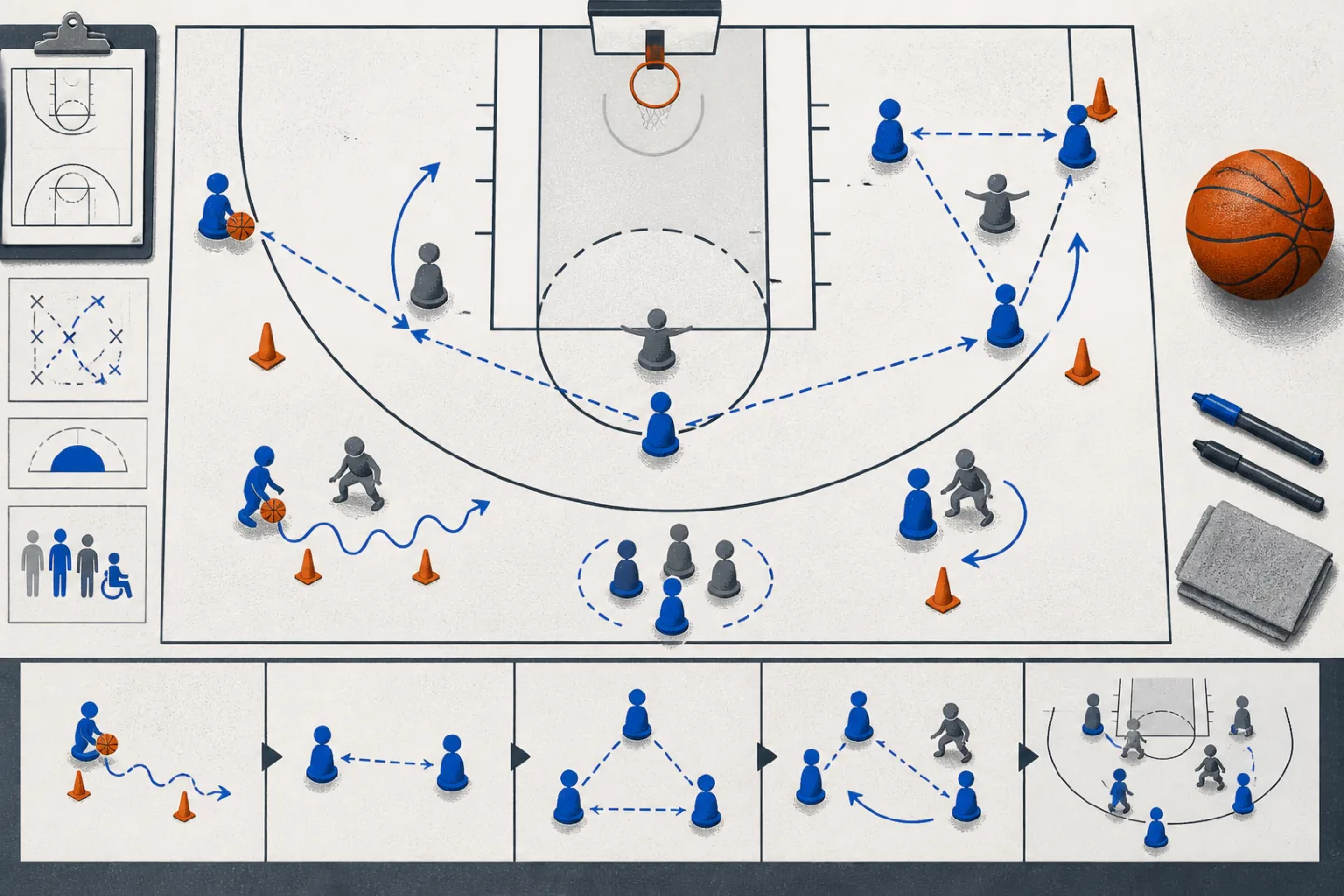
A simple session can move through the following stages:
- A gradual warm-up that includes running, changing direction and handling the ball.
- A brief demonstration of the main skill, followed quickly by practice.
- A paired or small-group activity that adds movement and light pressure.
- A small-sided game with a rule that encourages the skill.
- A short review in which players identify what helped them succeed.
Reduce waiting wherever possible. Use small groups, several stations and enough balls for players to practise at the same time. In a shooting activity, one player can shoot while others pass and rebound, with roles changing regularly. If a queue forms, change the organisation rather than asking players to wait.
Teach skills through simple progressions
Dribbling
Start with a balanced stance, bent knees and eyes forward. Players should push the ball with controlled fingertips and keep it beside the body. Practise each hand before adding movement, changes of direction or a defender. Encourage players to slow down before changing direction and then move away with control.
Passing and receiving
Teach players to pass towards a teammate's hands or away from a nearby defender. The receiver should show a target, watch the ball and bring it under control before deciding whether to pass, dribble or shoot. After passing, players should move with purpose instead of standing still.
Small games reveal whether a player can recognise an open teammate. Adjust the rules to emphasise the lesson: limit dribbles, reward a pass followed by a cut, or require the team to use both sides of the court before shooting.
Shooting and finishing
Begin close to the basket, where players can use comfortable technique. Check that the shooter is balanced, the shooting hand supports the ball from underneath and the guide hand does not push it sideways. The player should extend towards the basket and land under control.
Build distance only when the motion remains steady. Include lay-ups from both sides and teach the footwork without assuming every player already understands it. Accuracy, balance and repeatability are more useful than forcing shots from beyond a player's comfortable range.
Defence
Teach a low, balanced stance and short lateral steps. The defender should watch the opponent's body, stay between the opponent and the basket, and avoid reaching across the ball handler. When closing out, players can approach quickly, shorten their steps and stop in balance with a hand raised.
Defensive drills should include recovery and communication as well as individual movement. Players need to learn how to help a teammate and then return to their own opponent without creating unsafe contact.
Use games to teach decisions
Isolated repetition helps players learn a movement, but games teach them when to use it. Small-sided play gives each participant more chances to handle the ball, defend and make choices. Change one rule at a time so the game still feels like basketball and the learning purpose remains clear.
Pause only when a correction will help several players. Long explanations interrupt concentration and reduce practice time. When possible, ask a question such as Where was the open space? or What passing option did you see? This helps players examine a decision rather than wait for every answer from the coach.
Give feedback players can use
Useful feedback describes an action and offers one manageable adjustment. Keep taking short steps as you approach the shooter is clearer than a general demand to defend better. Give the player another attempt soon afterwards, then recognise the change when it appears.
Praise choices and habits that players can repeat: looking before passing, returning quickly on defence, communicating with a teammate or trying the weaker hand. Avoid sarcasm, public embarrassment and comparisons between players. Correct privately when possible, especially if the issue concerns confidence or behaviour.
After an error, use a brief reset. The player can breathe, identify the next responsibility and rejoin play. A missed shot or turnover may follow a sensible decision, while a successful play can still hide poor judgement. Discuss the process as well as the result.
Share opportunities fairly
Explain how playing time and roles will be managed before competition begins. Developmental teams should give every player meaningful chances to participate, practise different skills and contribute to the group. A rotation note can prevent game pressure from narrowing opportunities to the most confident players.
Adapt activities for different experience levels without isolating anyone. A smaller area, an extra pass, a passive defender or more time can make a task accessible. A confident player can face tighter space, a weaker-hand condition or a quicker decision. Both versions should practise the same central skill.
Protect safety and well-being
Inspect the court before activity and remove loose equipment or moisture. Begin with gradual movement, then add changes of direction, jumps and basketball actions. Teach players to land with balance, stop without colliding and defend without pushing, holding or moving beneath someone in the air.
Make water available and provide breaks suited to the conditions and intensity. Watch for unusual fatigue, confusion, poor coordination, breathing difficulty, dizziness or pain. Stop the player from taking part when symptoms suggest that continuing may be unsafe, and involve a parent, guardian or qualified health professional as appropriate.
A suspected concussion needs careful handling. Remove the player from activity and follow the organisation's medical and safeguarding procedure. The coach should not diagnose the injury or decide that a player is ready to return simply because the player says they feel better.
Emotional safety matters too. Set firm expectations against bullying, discriminatory comments, dangerous play and humiliation. Learn how the club or organisation handles safeguarding concerns, injuries and emergencies before the season starts.
Work constructively with families
Give families a clear outline of schedules, attendance expectations, equipment, sideline behaviour, playing-time principles and the process for raising a concern. Ask caregivers to encourage the team without directing play, criticising officials or comparing children.
Discuss difficult matters away from the court and not immediately after an emotional game. Listen for specific examples, explain what you observed and agree on a practical next step. Protect every player's privacy; a conversation about one child should not include details about another.
Safety, bullying or repeated misconduct should follow the organisation's reporting procedure promptly. Keep factual notes of what was reported and what action was taken where policy requires them.
Review and improve
After each session, note which activity supported the goal, where players waited, what caused confusion and who received too few chances to take part. Choose one or two changes for next time.
Continue learning about child development, safeguarding, first aid, communication and basketball instruction. Test new ideas in a small, controlled way and judge them by how well players understand and apply the skill. Good youth coaching is steady work: prepare with purpose, observe carefully and make the next session a little clearer than the last.
Keep going with www.siilinpadel.fi.